Episode 01 | Solo
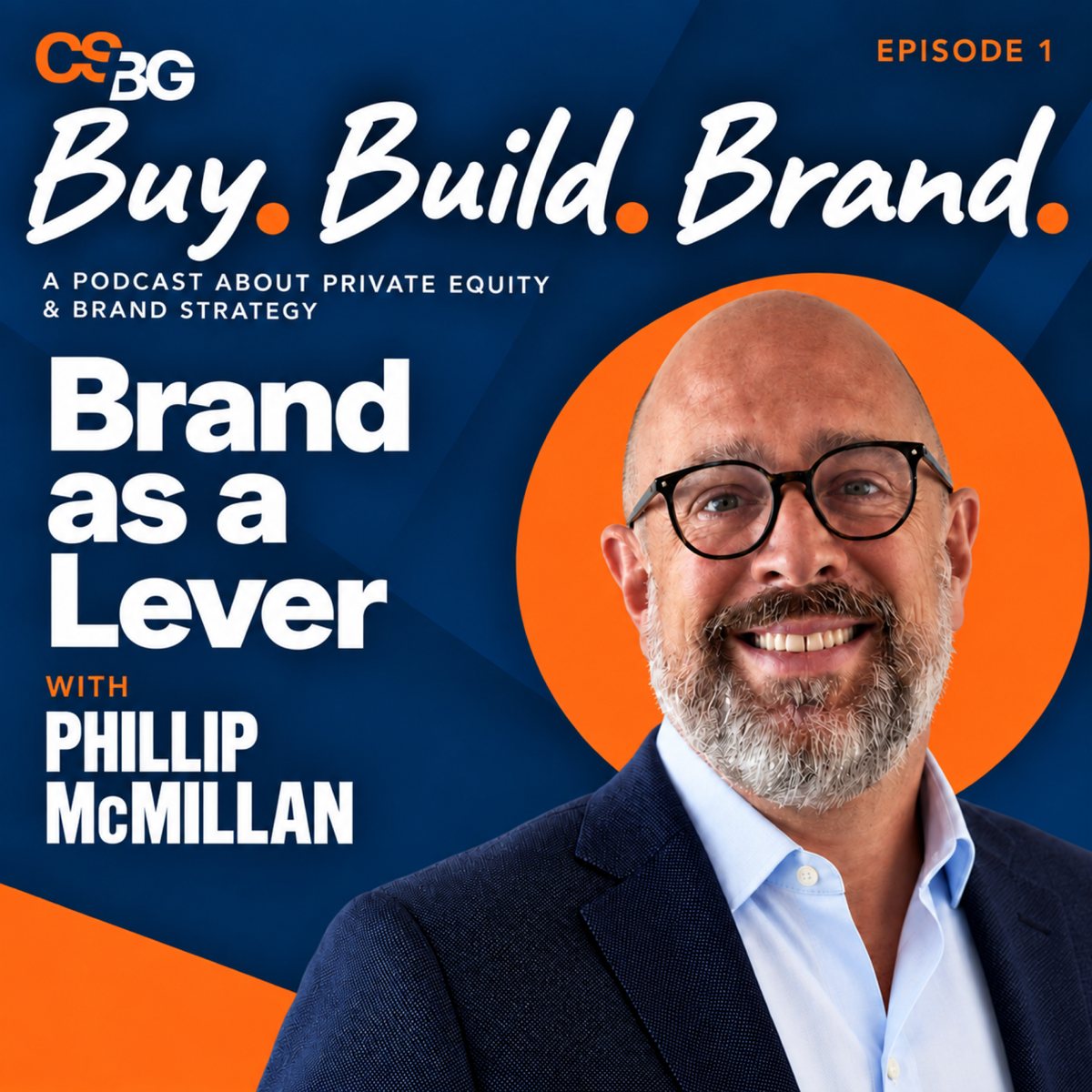
Brand as a Lever
With Phillip McMillan, Founder and Managing Director, CS Brand Group · Hosted by Phillip McMillan · 11:47







A sponsor buys a business because they believe something about it the market hasn’t figured out yet. If that thesis lives only in the deal memo and the board deck, the company goes to exit looking a lot like the business they bought.
In this solo episode, Phillip McMillan lays out the frame for Buy. Build. Brand. He defines brand the way a deal team can use it: what the market believes about your business before anyone from that business is in the room. That belief is pricing in your favor or against you, and it rarely shows up as a line on the P&L, which is why nobody budgets for it.
In this episode
- A working definition of brand for sponsors, operating partners, and portfolio company CEOs
- The 3 ways the gap between the investment thesis and the market’s story shows up: the story falls behind the thesis, the company outgrows its brand, and the company needs a brand from day one
- A real example: a business whose high-margin testing and maintenance services were invisible to a market that still saw it as a parts and break-fix provider
- Where AI fits, in Phillip’s words: “AI makes the expert faster, but the expert makes the answer right.”
- 3 questions to ask about any portfolio company, and when each one is cheapest to answer: in the first 100 days, before close, and 12 to 24 months before exit
Pull up your homepage, give it 30 seconds with no banker in the room, and ask whether it tells the story you’re selling.
Full transcript
Read the full transcript
Phillip McMillan (00:01)
Here’s a scenario I’ve watched play out more times than I’d like. A sponsor buys a business, a good business. They paid for it because they believe something about it that the market hasn’t figured out yet. That belief is the investment thesis. It’s the whole reason the deal made sense. And then for the next four or five years—in today’s market, maybe longer—the thesis lives in the deal memo and the board deck, but nowhere else.
Phillip McMillan (00:31)
Customers never really hear it. The recruits never really hear it. The next buyer has to be
Phillip McMillan (00:36)
Walked through it by a banker slide by slide because nothing about the company says it out loud. So at exit, the sponsor sells a business that looks a lot like the one they bought, plus some add-ons and maybe a better ERP. They paid for a thesis, but they’re selling a commodity. The gap between those two things is real money left on the table because nobody owned the job of making the market believe what the sponsor recognized themselves. That’s what this episode is about.
It’s what this whole podcast is about. Welcome to Buy. Build. Brand. Real conversations on how brand drives value in M&A. I’m Phillip McMillan, managing director of CS Brand Group. Most of the skepticism about brand in a deal room just comes from a bad definition, from a lack of understanding. If a brand is simply defined as a logo, a tagline, some colors, then yes, you’re right. It doesn’t belong in a value creation plan. It’s a line item, and I’d argue a small one.
But here’s the definition I’d give a deal team. Brand is what the market believes about your business before anyone from that business is in the room. It’s what a customer believes before the sales rep calls. It’s what a candidate assumes before their first interview. It’s what a buyer’s associate concludes in the first 30 seconds of scanning your website before they ever open the CIM. That belief is either pricing in your favor or pricing against you. There’s no neutral ground. So brand isn’t just the logo.
Yes, the name, the messaging, and the visuals all matter, but they’re expressions of something underneath them, the story. And for a sponsor, that story is closely tied to the investment thesis, translated for everyone outside the boardroom. When it’s missing, it leaks value in ways that won’t land on the P&L, which is exactly why nobody budgets for it. In practice, the gap shows up three ways, again and again. And if you spent any time in private equity, you’ve probably lived at least one of these.
The first is the quietest. The story falls behind the thesis. Nothing dramatic happened. There’s a new sponsor, a new strategy, a hundred-day plan. But the website, the sales deck, and the way the reps describe the company all still reflect where the business used to be. Nobody decided to leave it that way. It just never became anyone’s job. And every day it stays that way, the market keeps buying and pricing the old company. The second is the company that has outgrown its brand.
Maybe it’s still named for the founder or for the product it made 20 years ago. But since then it’s added capabilities, moved upmarket, opened new verticals. Management knows what the business has become. The board knows, but the market doesn’t. And that gap is most expensive at exit because when the equity story in the CIM doesn’t match the story the market can see, the buyer believes the market every time. The third is the company that needs a brand from day one. A carve-out that was a division on Friday and on its own on Monday, a platform that just merged with a competitor, a roll-up with five or ten acquired names, each with real local equity.
Customers want the answer to a simple question: Who am I doing business with now? Employees ask a harder one, what am I part of? If there’s no good answer, people fill the silence themselves, and it’s rarely in your favor. Three different situations, one root problem, the gap between the business the sponsor is building and the story the market hears. Brand is at the intersection of how you close that gap. Let’s give you an example. Let’s make that third one concrete. I had the chance to work with a CEO of a business where over half the revenue was from recurring maintenance on critical electrical systems at large industrial facilities.
Over the course of that sponsor’s hold, they’d also been successful in bolting on several companies that added on an array of testing services. High-margin, highly complex, highly regulated, with a high barrier to entry. But when you went to their website, to the market, they were defined as selling refurbished electrical components and break-fix services. The problem wasn’t the logo, it was a belief. Cross-sell isn’t a sales problem, it’s a belief problem. Customers buy more from a company they understand as one thing. And every month that that question went unanswered, the business paid for it without a line in the model to show it.
Now, a lot of times, a firm may look at this, a management team may look at this and say, Well, can’t we just solve this with AI? Of course, that’s the go-to question for pretty much every problem in an organization today. But it comes up in these conversations because people really don’t understand the expertise required to solve these problems. You see, the right answer isn’t either people or AI, it’s experienced people using AI well. Now, of course, we use these tools every day, all of us do.
They make the research faster and wider. They can pressure-test positioning against an entire competitive set in an afternoon and help us to get a strong draft on the table before the meeting instead of after it. But better tools, like AI, make judgment more valuable, not less. Someone still has to know which question matters in this deal, hear what the CEO isn’t saying and get the alignment between the sponsor and the management team. Get them committing to the same answer. That alignment is where value truly gets created.
AI makes the expert faster, but the expert makes the answer right. So where do we take this? Well, here’s something we can use on Monday. Three questions I hear from sponsors and CEOs all the time. And if you’ve ever asked them about a company in your portfolio, then you already know where brand could be a lever. First, why does our website still say that? That’s the story falling behind the thesis. It usually surfaces in the first hundred days, which is also when it’s the cheapest and easiest to fix.
Second, what do we call this now? That’s a company that needs a brand from day one. It comes with the carve-out, the merger, the add-on that changes the landscape of what the business is. The best time to answer that? Before close. Third, will buyers see what we’ve built? That’s a company that’s outgrown its brand and it needs to be answered 12 to 24 months before exit, not when the CIM goes out. Pull up your homepage, give it 30 seconds with no banker in the room.
Be honest with yourself, self-assess. If any of these sound familiar, brand is already a lever in that deal. The only question is whether or not someone owns it and whether you wait until exit to find out what it costs. That’s the frame for this show. Brand decisions in a deal don’t belong to one seat at the table. The sponsor sets the thesis, but the CEO and the operators have to live it every day. The bankers have to tell it to the next buyer.
And the advisors from the attorneys to the integration leads are usually the first to see where it breaks. So that’s who you’ll hear from here. Operators, CEOs, investors, bankers, and advisors talking about the brand decisions they’ve made inside real deals. Not theory, what they decided, what it cost, and what they’d do differently. If you want to compare notes on a deal you’re looking at, you can find me and the team at CSBG. Our website is csbg.co. Whatever you do, have the brand conversation before it becomes a diligence question.
I’m Phillip McMillan. Thanks for listening to Buy. Build. Brand.
This transcript has been lightly edited for readability.
About the host

Phillip McMillan
Founder and Managing Director, CS Brand Group
Phillip works with private equity funds and their portfolio companies on brand strategy through platform development, acquisitions, integrations, and exits.
More conversations
Keep listening.
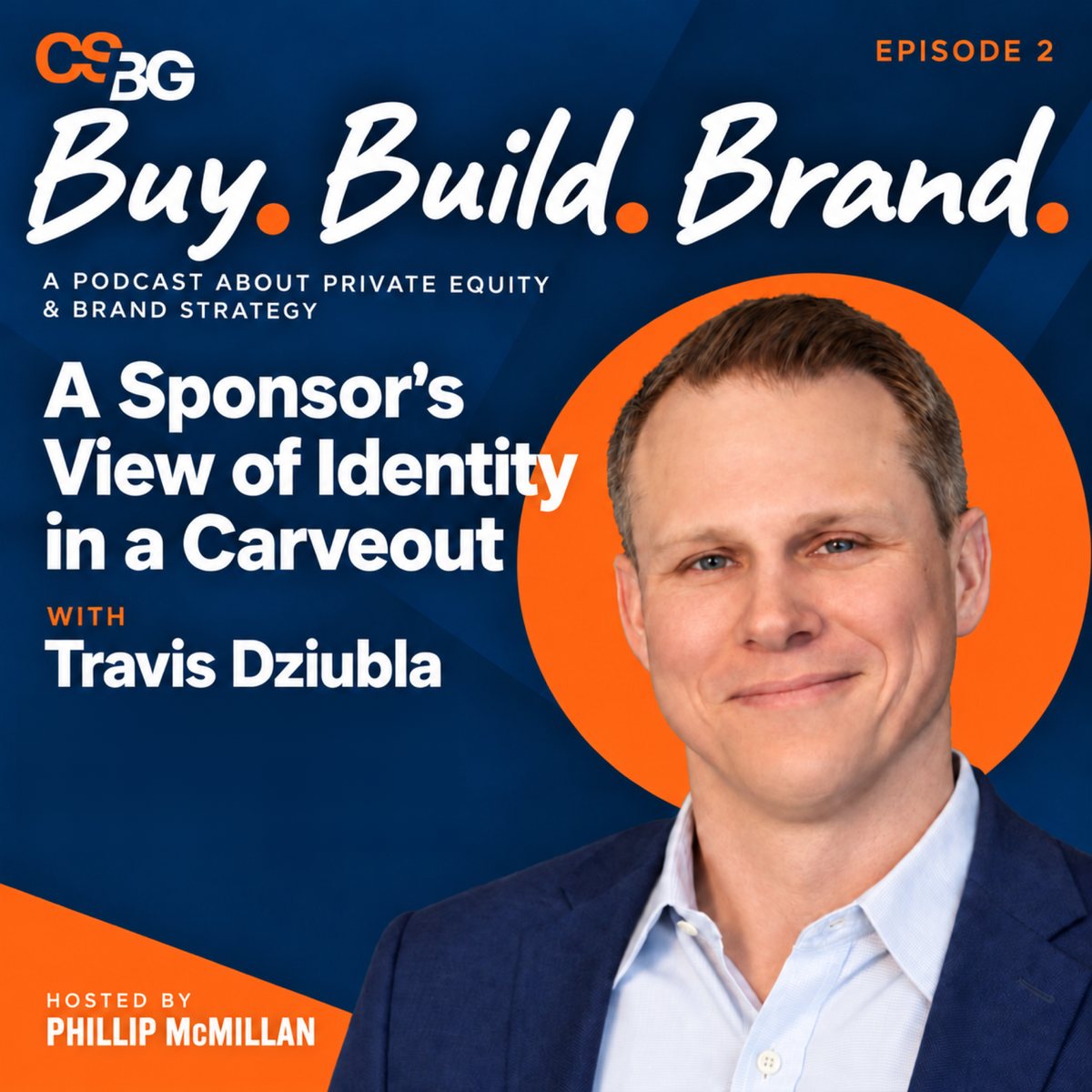
Episode 02 | Guest conversation
Travis Dziubla
Managing Director, Pacific Avenue Capital Partners
Travis Dziubla discusses when identity work should begin, who needs a voice, and what a business risks when it postpones those decisions.

Episode 03 | Guest conversation
John Pickerill
Chair, Advertising, Marketing & Trademark Law Group, Fredrikson & Byron
What should a buyer know about the name a business operates under? John Pickerill discusses registration uncertainty, pending marks, and the brand protection questions that belong in M&A diligence.
Keep the conversation going.
Follow Buy. Build. Brand. on your preferred podcast app for future episodes.